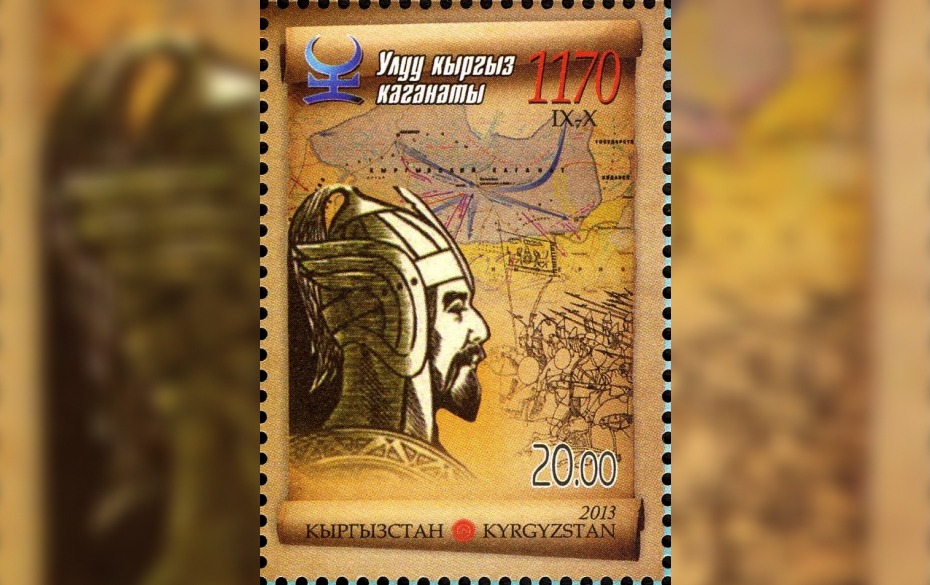
The Kyrgyz are one of the most ancient and freedom-loving peoples in the world. It is remarkable that the self-name of the Kyrgyz people, “Kyrgyz,” has not changed for more than 2,000 years. It is probably not an exaggeration to say that the Kyrgyz are among the few peoples in the world who have preserved their ethnonym from ancient times to the present day, that is, into the second millennium AD.
The fact that the Kyrgyz preserved their national identity and the self-name “Kyrgyz” for several millennia is worthy of admiration.
The earliest information about the Kyrgyz comes from ancient Chinese written sources. Various forms of the name Kyrgyz appear in them long before the medieval period. The main territories of the ancient Yenisei Kyrgyz were located in the Upper Yenisei region — in present-day Khakassia, Tuva, and adjacent areas of southern Siberia.
Natural conditions shaped the characteristics of their economy and culture. Horse breeding, livestock raising, hunting, and trade played important roles. At the same time, the Kyrgyz maintained connections with settled agricultural and trading centers of Central Asia.
In the early medieval period, Kyrgyz rulers entered into complex relations with neighboring Turkic and Mongol political formations, as well as with Chinese dynasties.
The struggle against the Uyghur Khaganate was of particular importance in Kyrgyz history.
In the 8th and early 9th centuries, the Uyghur Khaganate was one of the leading powers of Central Asia. Its political center was located in Mongolia, and its influence extended far beyond Mongolia itself.
The Yenisei Kyrgyz lived far to the north, but they gradually grew stronger. Prolonged wars took place between the Kyrgyz rulers and the Uyghurs. The struggle was not only military but also commercial and political in nature: control over steppe communications, territories, and relations with neighboring states was important.
The turning point came in 840.
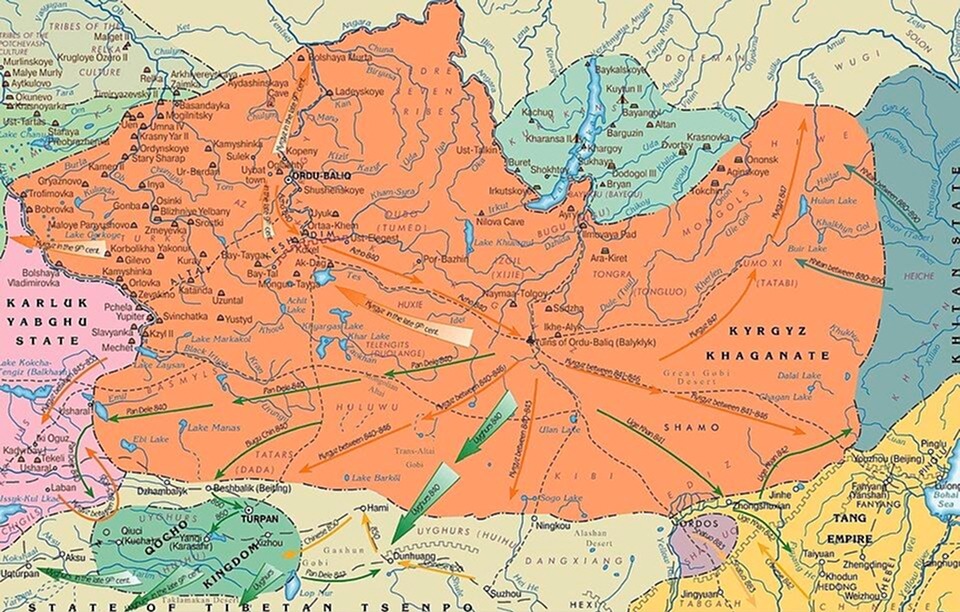
In 840, the army of the Yenisei Kyrgyz defeated the Uyghur Khaganate and captured its capital, Ordu-Baliq, in the Orkhon Valley.
This event became one of the greatest political turning points in the history of Central Asia in the 9th century.
After the destruction of the Uyghur Khaganate, the previous system of political dominance in Mongolia was disrupted. Part of the Uyghur population migrated south and west, to the regions of Eastern Turkestan and Gansu. Other groups moved to various parts of Central Asia.
The Kyrgyz khagan began to claim the position of supreme ruler over a significant part of the steppe.
It is precisely this period that is associated with the concept of the Kyrgyz Khaganate as a major power of its time.
After the victory over the Uyghurs, the center of Kyrgyz political influence shifted considerably farther south than its previous territories. Kyrgyz rulers sought to control areas of Mongolia and maintain relations with the states of Eastern and Central Asia.
In 848, a 70,000-strong Kyrgyz army under the command of the military leader Abo marched into Manchuria against the Shivei and the Uyghurs led by Eñän Delü-khan. After the victory, the Kyrgyz took 500 noble Uyghurs captive and reached Ordos and the Great Wall of China.
“He inflicted a severe defeat on the Shivei people, then gathered all the Uyghurs who were among the Shivei and returned them north of the Gobi.”
Excerpt from the Book of Tang.
The Kyrgyz Great Power of the 9th century became one of the most remarkable periods in the history of the Kyrgyz world. The victory over the Uyghur Khaganate in 840 changed the political map of Central Asia and, for a time, elevated the Kyrgyz among the leading powers of the Eurasian steppe.
The history of the Kyrgyz people is very rich. Especially during the 8th–10th centuries AD, the Kyrgyz reached the peak of their power and created a vast state: the Kyrgyz Khaganate.
Academician Vasily Bartold introduced the historical term “Kyrgyz Great Power” to describe the period from 840 to 924, when the Kyrgyz Khaganate dominated Central Asia.
I would call this period the Kyrgyz Empire.
The territory of the Kyrgyz Empire was about 8 million square kilometers, making it much larger than several well-known empires.
For example, the Roman Empire covered about 5 million square kilometers, the Achaemenid Persian Empire about 5.5 million square kilometers, and the French Empire 3.5 million square kilometers.
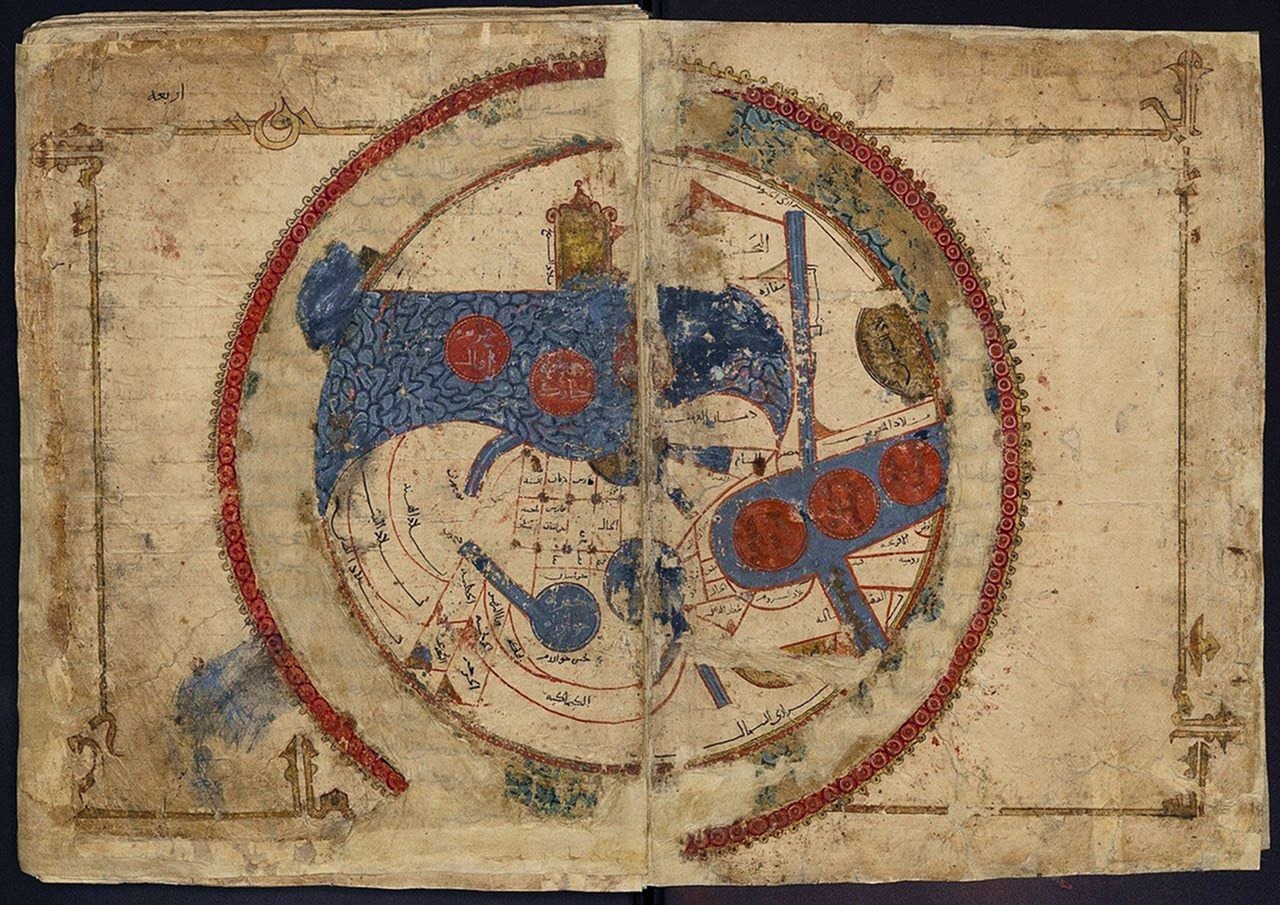
According to Hudud al-Alam, the residence of the Khyrkhyz Khagan was located in the city of Kemidjket, which was the capital of the Kyrgyz Khaganate.
“The region of Khyrkhyz: to its east is the region of China and the sea — the Eastern Ocean; to its south are the lands of the Toquz-Oghuz and partly the Qarluq; to its west are the lands of the Kimak; and to its north are the uninhabited lands of the north. Their ruler is called the Khyrkhyz Khagan.”
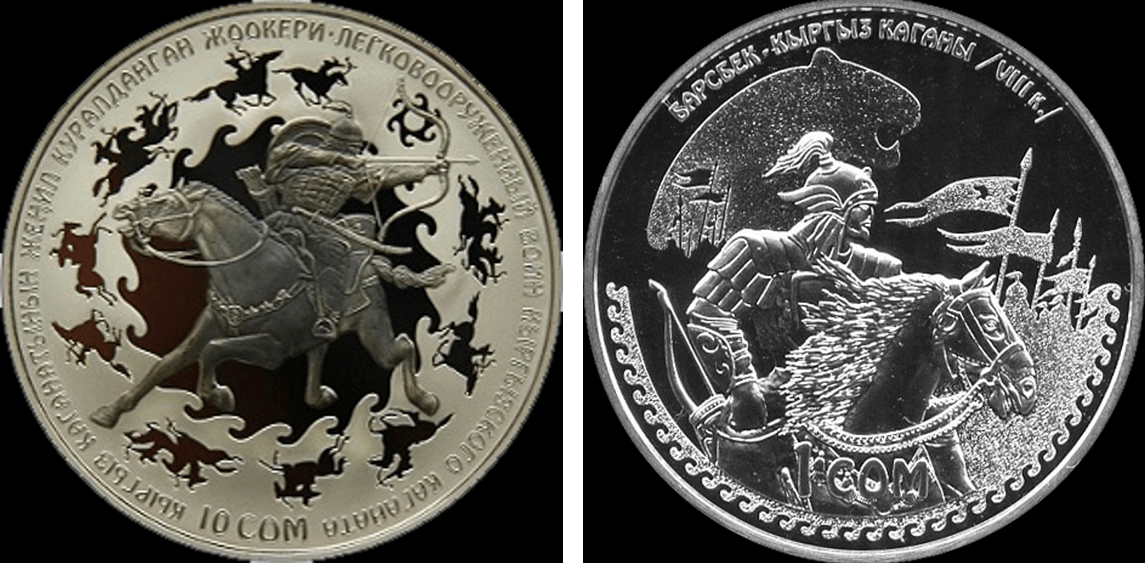
The army of the Kyrgyz Khaganate during the reign of the Khyrkhyz Khagan remained combat-ready. The regular army numbered 30,000 men; during mobilization, troops were assembled from all vassal clans.
A Chinese envoy of the Song dynasty period noted the following:
“They usually produce good iron, called ‘jiasha.’ This is that very iron. As for their weapons, it should be said that they make extensive use of shields, bows, and arrows. Their horses are equipped with shields from the belly to the legs. They also make shields and attach them to both shoulders, which can be used effectively. Shields designed to deflect arrows are made as follows: wood is split and joined with a crossbar; arrows cannot pierce such a shield. They also have standards and flags. Their ruler established one standard, whose lower part is entirely red.”
The Kyrgyz were excellent warriors.
The foundation of Kyrgyz power was a cavalry army. Like other steppe peoples, the Kyrgyz possessed high mobility and could conduct campaigns over enormous distances.
The victory of 840 demonstrated the ability of the Kyrgyz state to conduct large-scale military operations far beyond the original center of their settlement.
Control over steppe routes also had economic significance. Trade routes passed through Central Asia, linking China, Mongolia, Eastern Turkestan, Central Asia, and regions farther west.
Kyrgyz society during the Khaganate era was part of the broader Turkic cultural world.
Oral tradition, warrior culture, clan and tribal ties, and a nomadic economy played major roles. At the same time, the Kyrgyz were not isolated from neighboring civilizations.
Goods, technologies, religious ideas, and cultural influences spread through Central Asia. In various regions connected with the Kyrgyz, there were contacts with Buddhist, Manichaean, Christian, and other religious traditions.
The history of this period shows that the ancient and medieval Kyrgyz were active participants in the international politics of Central Asia, maintained diplomatic relations with major neighboring powers, and controlled important parts of the Eurasian space.
Two particularly interesting historical descriptions are worth highlighting; this is a subject for a major scholarly and historical study:
1. The military-political expansion of the Yenisei Kyrgyz to the west reached the steppe and forest-steppe regions of southern Western Siberia.
The newcomers from the heart of Asia apparently contributed to the departure of the ancient Ugrian-Magyar peoples from the Cis-Ural region. This is supported by archaeological finds in the south of Chelyabinsk Oblast (burials of the so-called Tyukhtyatka culture). In the 9th–10th centuries, the standards of the Yenisei Kyrgyz reached the borders of Europe.
Groups of Yenisei Kyrgyz fought their way first to the regions of the Aral Sea and the Syr Darya, and then to the North Caucasus, the Black Sea region, the Volga, and Crimea. As a result of these expeditions, the ethnonym “Kyrgyz” and “Khyrkhyr” became widespread across the Eurasian steppe. In Crimea, the Kyrgyz-Az established the domain of Qirq-Yer with the Uzun dynasty, which ruled until the 14th century; on the Volga, an ulus of the Yenisei Kyrgyz was established.
2. Founder of the Karakhanid Dynasty (Karakhanid State)
Bilge Kul Qadir Khagan came from the Edgish clan of the Chigil tribe, which was part of the Karluk tribal confederation. The Chigil tribes lived near Issyk-Kul, in present-day Kyrgyzstan. From 791, the Karluk rulers were subordinate to the authority of the Uyghur khagans and bore the title yabghu.
During the war between the Uyghurs and the Kyrgyz, which lasted more than twenty years, the Uyghur Khaganate was destroyed in 840. Taking advantage of the temporary power vacuum, a number of influential Karluk nobles living near the western borders of the vast Uyghur Khaganate decided to restore their lost independence and proclaimed their leader — the ruler of the major trading city of Isfijab — as khagan.
There is an opinion that this ruler was related either to the Kyrgyz khagan who defeated the Uyghurs or to the Karluk Kyrgyz-origin clan Kara-Chor, and therefore his separation from the khaganate did not lead to consequences.
The history of the Kyrgyz Great Power : the Kyrgyz Empire is a vast subject; naturally, it is impossible to describe it in one or several publications. We will gradually cover the history of the states created by this brave Kyrgyz people.
Prepared by Prof. T. Chagataikhaan