
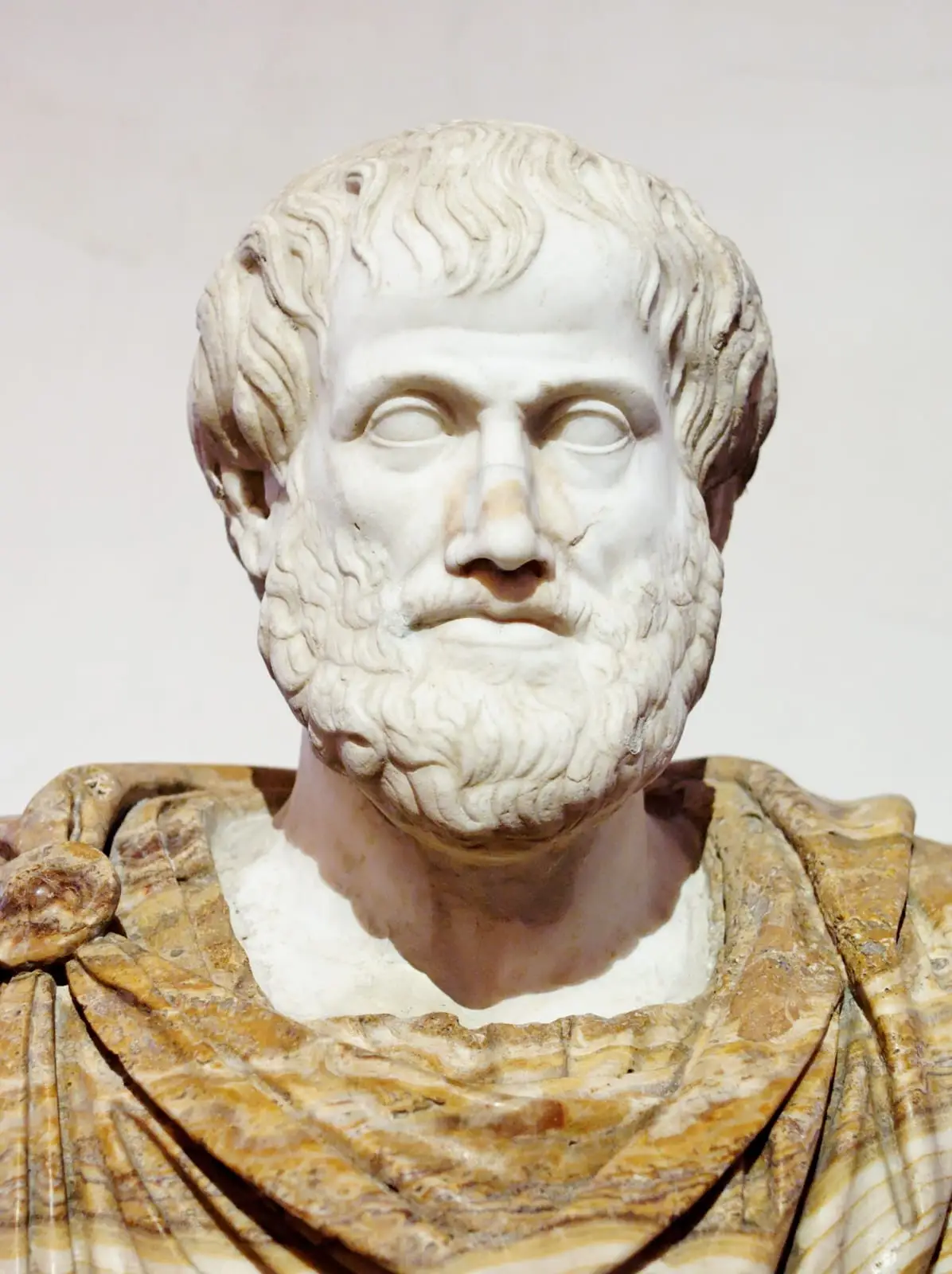
Aristotle (384–322 BC) was an outstanding ancient Greek philosopher, scientist, and thinker, one of the founders of European science. His ideas had a profound influence on the development of philosophy, logic, politics, ethics, biology, physics, and the theory of state and law. Aristotle was the teacher of Alexander the Great, the founder of the Greek Empire.
Aristotle was born in 384 BC in the city of Stagira, located in northern Ancient Greece. His father, Nicomachus, was a physician at the royal court, so from an early age, the future philosopher was interested in nature and living organisms.
At about the age of seventeen, Aristotle went to Athens and entered the Academy of the famous philosopher Plato. There he spent about twenty years studying philosophy, mathematics, and other sciences.
After Plato’s death, Aristotle continued his independent research. He was later invited to the court of the Macedonian king Philip II, where he became the tutor of the young Alexander the Great. Aristotle taught him philosophy, politics, literature, and the foundations of scientific knowledge.
In 335 BC, the philosopher returned to Athens and founded his own school, the Lyceum. Here, he and his students engaged in the systematic study of nature, society, government, and human thought.
Aristotle sought to explain the world not only through abstract reasoning, but also through observation, analysis, and study of concrete phenomena.
The philosopher investigated the essence of things, their properties, the causes of their origin and change. He believed that to understand an object, it is necessary to study both its material basis and the form that makes it what it is.
The Doctrine of Four Causes
Aristotle identified four types of causes that explain the existence of things:
* Material cause – what an object consists of.
* Formal cause – what determines its structure and essence.
* Efficient cause – what causes its origin. * A final cause is the purpose for which something exists or is created.
Aristotle is considered one of the founders of formal logic. He developed the doctrine of the syllogism—a form of reasoning in which a conclusion follows from two premises. His works laid the foundation for the systematic study of correct thinking.
In his work, Nicomachean Ethics, the philosopher explored questions of happiness, virtue, justice, and the meaning of human life.
Aristotle believed that the highest human goal is happiness, understood not as fleeting pleasure, but as a full and rational life based on virtue.
He attached particular importance to the principle of the golden mean. According to this approach, moral virtue often lies between two extremes.
For example, courage occupies a middle ground between cowardice and reckless daring.
Aristotle believed that virtue is formed through education, habit, and conscious choice. A person becomes just by doing just things.
In his work “Politics,” Aristotle examined the origins of the state, forms of government, citizenship, and the conditions for social well-being.
His famous idea is that humans are by nature political beings. This means that people are capable of fully realizing their potential primarily in society, interacting with one another and participating in public life.
Aristotle distinguished between correct forms of government, oriented toward the common good, and their distorted forms.
It is important to note that Aristotle used the concepts of democracy and polity in a sense different from the modern understanding of democracy.
He believed that a stable state should ensure order, justice, and conditions for a dignified life for citizens. The philosopher placed great importance on law, education, and moderation in politics.
Aristotle left a significant legacy in various fields of knowledge.
* Biology: He studied animals, compared their structure and behavior, and systematized observations of living nature.
* Physics: He investigated motion, space, time, and the causes of natural phenomena. Some of his physical concepts have subsequently been revised by science. * Metaphysics: analyzed being, essence, possibility, and reality.
* Poetics: examined tragedy, literary works, and the impact of art on humanity.
* Rhetoric: studied the arts of persuasion, argumentation, and public speaking.
* Ethics and Law: examined justice, equality, the distribution of goods, and the role of laws in social life.
Aristotle’s Significance for Legal Philosophy
Aristotle’s ideas on justice, law, and the state are particularly important.
For him, justice is associated with the proper distribution of goods, the maintenance of equality, and the restoration of a disturbed order. He distinguished between distributive justice and corrective justice.
Concerns how social goods and responsibilities are distributed among people. Corrective justice aims to eliminate harm and restore balance between parties.
Aristotle also explored natural and human-imposed justice. His thoughts became an important part of the subsequent development of European legal philosophy.
However, the philosopher lived in a society where slavery existed and did not recognize the equality of all people in the modern sense. Therefore, his legacy must be considered in light of historical conditions and individual provisions of his teaching must be critically assessed.
Aristotle’s Major Works
Nicomachean Ethics
An investigation of morality, virtue, justice, and human happiness.
Politics
A work on the state, citizenship, laws, and forms of government.
Metaphysics
A philosophical study of being, essence, and first causes.
Poetics
A work on literature, tragedy, and the nature of artistic creativity.
Aristotle occupies a special place in the history of world thought. He sought to combine philosophical reasoning with observation, systematization of knowledge, and logical proof. His ideas shaped the development of education, science, ethics, political theory, and legal philosophy for many centuries.
Aristotle’s main legacy lies in his quest to understand the world through reason, to investigate the causes of phenomena, and to determine how individuals and society can achieve a good and just life.
His works continue to be studied by philosophers, historians, lawyers, and scholars throughout the world. Aristotle remains one of humanity’s greatest thinkers, having had a fundamental influence on the development of civilization.
Prepared by Dr.S.Erdenebulgan