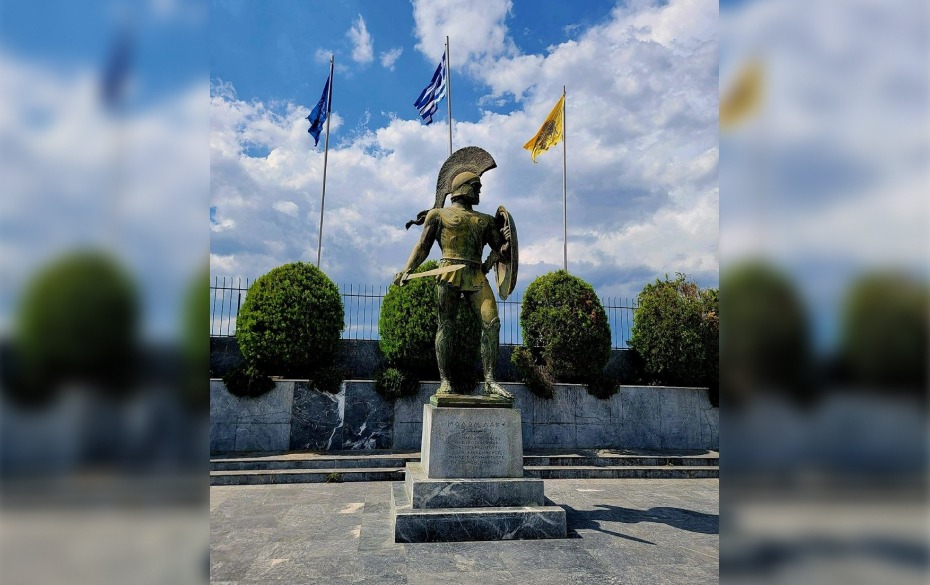
King Leonidas I — an outstanding Greek commander and the hero of Thermopylae — was born around 519 BC in Sparta and died in 480 BC.
Leonidas I was a king of ancient Sparta from the Agiad dynasty and one of the most renowned military leaders of ancient Greece. He is best known for his role in the Battle of Thermopylae in 480 BC, where a small Greek force stood against the massive army of the Persian King Xerxes I. Leonidas hailed from the royal Agiad line. Following the death of his older half-brother, King Cleomenes I, Leonidas became one of Sparta’s two co-ruling kings — a dual monarchy system that was a unique feature of the Spartan state.
Leonidas reigned from approximately 490 to 480 BC. His name roughly translates to “son of a lion” or is associated with the ancient Greek name Leonidas.
In 480 BC, the Persian King Xerxes I launched a major invasion of Greece. Greek city-states united to resist the attack. Leonidas was given command of a Greek contingent that occupied the narrow pass at Thermopylae. According to ancient sources, he initially commanded a force of about 7,000 Greeks, including the famous 300 Spartans.
The Persian army vastly outnumbered the Greeks. However, the narrowness of the pass allowed the defenders to offset the enemy’s numerical superiority. For several days, the Greeks successfully held back the Persian advance. The Greeks’ situation changed after a local man named Ephialtes showed the Persians a mountain path that allowed them to outflank the Greek position.
Realizing that encirclement was inevitable, Leonidas ordered the majority of the allied forces to retreat. He himself remained behind with the Spartans and some allies to hold off the Persians.
Leonidas fell during the final battle at Thermopylae in 480 BC.
The Spartans and their allies fought to the very end. Although the Persians succeeded in capturing the pass, the Greek resistance became one of the most renowned episodes of the Greco-Persian Wars.
The historical significance of Leonidas lies not so much in the immediate outcome of the Battle of Thermopylae as in its military and symbolic importance. The resistance put up by this small band of defenders became, in later Greek and European tradition, an enduring example of martial steadfastness, discipline, and the willingness to sacrifice oneself for the defense of one’s state.
A monument bearing a famous epitaph dedicated to the fallen Spartans was later erected at the battle site:
“Stranger, if you go to Sparta, tell them that, having died here, we obeyed her laws.”
The distinguished Greek commander Leonidas I went down in history as one of Sparta’s most famous kings, and Thermopylae became a symbol of resistance against a vastly superior enemy force.